24 November 2010

The Geek Shall Inherit the Earth

Somehow I've managed to have some kind of movie-watching convergence in the last couple of weeks.  Evan and I went to see "The Social Network" and were impressed by the film's portrayal of Mark Zuckerberg as a brilliant, arrogant, determined nerd with a definitely flawed understanding of the people around him.  We spent lots of time afterward picking apart the details of the story (the lawsuits, what might have actually happened, the portrayals of the other characters), but we couldn't help talking about the drive for power that seemed to grow out of social rejection (and how someone with minimal people skills could have started an internet phenomenon that ultimately is concerned with social interaction).  We also thought about how paranoid Facebook (and Zuckerberg) really is in a way, with all that emphasis on "friend" counts and what your "friends" are doing at any given moment and where -- are you being left out of the party?? -- and various other cyber-stalking elements.  
The next morning, I went to see Das Rheingold -- the Metropolitan Opera's performance in HD, which can be seen at movie theaters around the world these days (and I highly recommend the experience).  The sets built for the new Ring Cycle at the Met are truly amazing.  I haven't been able to find much that is useful on the internet that really shows them in their best light, but here are some photos of them as well as a YouTube video. 


I did love one comment I read somewhere that the set is so slick and modern that it makes it seem as though the Vikings had alit on a space station, but my point in writing isn't really about whether the sets work for the story.  I was the only person under 50 in the movie theatre, and other than being unable to open the plastic wrap on my nanaimo bar (they have them here!) so that it melted in my pocket - thankfully all within the wrap -- I thoroughly enjoyed myself.  I've seen Das Rheingold before, in Seattle, and this second time it seemed equally obtuse and strange, while also seeming, particularly in the parts involving Alberich, oddly familiar.  I was thinking as I left the theatre about the character's vanity, duplicity and avarice, and I couldn't help thinking that there was some connection I needed to make between the opera I had just seen and the movie I had seen the night before.  And then it came to me.  Maureen Dowd had written a column a few weeks earlier, which I read, that linked Das Rheingold (she seems to have seen it live at the Met) with the Social Network.  Her basic point was that from an 1854 Wagner opera to “The Social Network,” the passions that drive humans stay remarkably constant.  The scariest line she wrote, and one I have been thinking about a lot with the recent rise of Sarah Palin and the Tea Party was: "It unfolds with mythic sweep, telling the most compelling story of all, the one I cover every day in politics: What happens when the powerless become powerful and the powerful become powerless?"  Wagner, it seems, was writing about the excesses of the capitalist system (he was a socialist).  The magic helmet, Tarnhelm, that Alberich has the Nibelung forge, was meant to symbolize a businessman's top-hat (according to George Bernard Shaw, whose work includes a lot of music criticism) and was designed to respectably disguise his exploitative behavior.  Wagner's commentary on the triumph of mammon is hardly disguised at the end of Das Rheingold.  As the gods, puffed up with pride and a false sense of security, strut across their bridge into Valhalla, where (they think) they're the lords of creation who have happily escaped the consequences of the evil they've let loose in the world, there is a telling exchange between Loge and the lamenting Rhinemaidens below (in German):

Loge:
You there in the water, why wail to us?
Hear what Wotan wills for you.
No more gleams the gold on you maidens:
henceforth bask in bliss in the gods' new radiance! 

Rhinemaidens:
Rhinegold, Rhinegold, purest gold!
If only your bright gleam still glowed in the deep!
Now only in the depths is there tenderness and truth:
false and faint-hearted are those who revel above!

The Social Network tells us this same story of ambition, greed, and casting aside loyalties to others via one of the current power elites - a "new" power based on databases and media.  However, despite the ultimate come-down of the privileged Winklevoss brothers in that story, the same narrative goes right along with more traditional sources of power - those controlling the bulk of the riches (CEOs, money managers, and yes, an increasing number of those whose wealth is not earned at all, but inherited).  Of course, in The Social Network, Zuckerberg, instead of discovering his authentic self, builds a database, turning his life — and ours — into zeroes and ones, which is what makes it also a story about the human soul, although I'm not sure that really lets Zuckerberg off the hook for his various betrayals.  And I'm still not sure how I feel about Facebook, despite the fact that I use it.  At some level, I suppose it is just another tool to enslave people and keep them from actually looking beyond the end of their own noses (or belly buttons more like) and seeing what is going on out there in the world.  

So although it doesn't directly follow from the movie, or the opera, watching both of these stories of heartless loners turning their backs on the world and building destructive forces (in that Facebook starts off as an angry, misogynistic, woman-rating site) that bring them great power and wealth, shifts my focus to the increasing wealth inequality statistics from the U.S.  I've read a lot of good articles about this, including a short but depressing column by Nicholas Kristoff, and a piece in Slate by Timothy Noah called The United States of Inequality that provides a lot of statistics.  Maybe Kristoff would approve of setting Das Rheingold in a Banana Republic, with Alberich playing a peasant in rags begging outside a grower's opulent villa, until the peasant steals a never-ending supply of coca, enslaves the peasants to process it for him and turns the ruling classes (Wotan would be dressed as a military dictator) into cocaine addicts . . . . Oh, but maybe not, because as Kristoff (and many others) points out, the income inequality in the U.S. is now more pronounced than in many of those countries.  Well, I suppose I digress, and I'll end this entry with the hope of writing about something more uplifting next.  


Oh, but I can't end here.  Because there is one quick piece of my movie convergence that I've so far left out.  This is only really meaningful if you have any idea how FEW movies Evan and I watch.  And I don't mean in the movie theater.  I mean at all.  Netflix was definitely making money off of us, at least since Ari was born, and even here where we theoretically have much less to do at night, we seldom rent movies, although we are getting better.  In any case, we don't watch many movies.  But after Ari broke his arm the other day, I was at the video store collecting some movies for him to watch, and I was wanting to hurry home, so I was quicky trying to decide on a movie for Evan and me as well.  After scanning the shelves for a while without finding anything that wasn't a new release (so we could keep it for more than a day), I turned to the "Festivals" shelf, which is where they have a bunch of flicks that have won awards at various film festivals, and grabbed The Squid and the Whale, thinking that I'd heard something good about it, and anyway I like Laura Linney and Jeff Daniels.  So Evan and I watched the movie a couple of nights later and afterward I said "OK, what have we just seen recently with that kid who plays the older son?"  Since we see so few movies, Evan was convinced I was just hallucinating, but of course, thanks to Google and the iPhone, within a minute we knew that we had just witnessed another great performance by Jesse Eisenberg, who plays Mark Zuckerberg so incredibly well.  A fun "aha" moment at least. 


By the way, apparently Alex Ross, in his blog in the New Yorker online, came up with the same link between Social Network and Rheingold that Dowd did - he just didn't flesh it out.  For fun, here's his entry from October 2, 2010 (minus the great picture of Eisenberg as Zuckerberg, wearing a hoodie and sitting in front of a whiteboard full of equations - he could certainly be starring in a math-oriented Lord of the Rings if not Rheingold):

Facebook as Rheingold


At the New Yorker Festival last night, I saw The Social Network, aka the Facebook Movie. It's a mesmerizing, acutely unsettling film, one that makes you want to wind back time. Maybe I have Wagner on the brain, but about fifteen minutes in I said to myself, "It's Rheingold." A social outsider, spurned in love, purloins from the beautiful people and forges a device that casts a spell on millions and gives its creator unimaginable wealth. Except that in this case Alberich is not so bad-looking and gets to keep his ring, if not his true heart's desire. Justin Timberlake is Loge, siding with the dwarves rather than the gods.


10 November 2010

Kowhai Park

This just deserves its own photo-post.  We had heard about this park in Whanganui and it was a big hit with Ari.  Interesting wedding-photo scenery . . . .


Blessedly Flat


Living in Seattle isn’t exactly living on the plains of North Dakota.  We have plenty of hills and living on Beacon Hill, as we do, I am used to walking uphill to get home from downtown, and I’d certainly think twice (or six times) before trying to walk home from the QFC on Rainier Ave, for instance, with a few bags of groceries, and one reason we haven’t biked much with Ari is that our ability to find reasonably level places to ride with him is hindered by the geography.  But I don’t have an overall sense of the city as being hilly, even though it is, because the hills are fairly gentle.  Leaving Wellington for the weekend to go to Whanganui though, one of the first things we noticed was how relatively flat it is.  Streets where you can see houses for blocks and blocks instead of 3 at a time.  Wide streets, with sidewalks on both sides.  It felt so calm.  Relaxing almost.


Whanganui (I love these audio pronunciation links) lies near the mouth of the Whanganui River, just a few km from where it meets the ocean.  It’s a prosperous town, with its river history and associated manufacturing, as well as being surrounding by agricultural areas.  The weather is much milder than it is in Wellington – we stayed in a cottage surrounded by an enormous vegetable garden and were amazed to see tomato plants (can you say “to-mah-to?”) already bearing fruit.  It’s the equivalent of early May at home.  We think we’ll be lucky to even get flowers on the two tomato plants we have braving our windy deck.  Our lovely garden also boasted a super-engineered hen-house, where 4 chooks (I’ll have to find the derivation of that) laid us some warm eggs for breakfast.  Whanganui boasts a really nice art museum, the Sarjeant Gallery, as well as a fine regional museum – all 4 of the exhibits we saw at the former were good, and Ari enjoyed them as well.  Unfortunately, the regional museum, where we had hoped to see an extensive collection of photographs from the late 19th/early 20th century detailing local Maori life, was closed for fumigating.  Oh well. 
 
I think we will likely head back to Whanganui, as our visit this past weekend was completely spur of the moment.  Two days before the weekend, when it looked like the weather wasn’t going to cooperate with our planned camping trip, I checked the MetService forecasts for every place within 5 hours drive of us on the North Island and landed on Whanganui as likely to have the best weather.  We had no plans before we arrived and didn’t know much about the town.  After a couple of days there, though, we both felt like we could even live there.  The river runs north into a national park and is the longest navigable river in NZ – there are lots of operators who do jet boat and canoe trips along the river – mostly starting farther up and going deeper into the park, and we are hopeful we’ll find the time to do a few-days trip a bit later this year.  Not clear if we’ll find anyone who will rent us canoes or kayaks with a kid under 8 years old, but there are other options.    Meanwhile, for this introductory trip, we found a jet boat operator who does some trips closer to Whanganui and into the lower part of the national park, and we enjoyed three hours with him and 2 other couples hearing about some history of the area and taking in the scenery.  Because he is Maori, he had some good legends to tell, and he shared some of his whakapapa, or family/tribal history with us.  
 
I learned something new about Whanganui after we got back to Wellington, which is that the spelling of the name (Wanganui vs. Whanganui) generated quite a bit of controversy recently.  Apparently the last mayor Michael Laws (who just declined to run for re-election in last month's elections, so he is gone now), who has had his share of controversial episodes during his political career, made a big fuss about the spelling change when the local "iwi" or (a Maori social group designation, kind of like a tribe or clan), petitioned the New Zealand Geographic Board to add an 'h' after the W to reflect the actual Maori spelling of the word meaning "big harbour."  (When the town was first given its Maori name, the consonant "wh" was not yet formally recognized as separate from "w" but there may also have been an issue with the regional dialect, which didn't make use of the "wh" sound -- so it's all a bit confusing.  Wanganui spelled without the "h" doesn't mean anything.)  The Mayor fought the request and got a referendum on the ballot regarding the issue - the vote came out overwhelmingly in favor of leaving the "h-less" spelling as-is, but voter turnout was low.  Given his background and continuing second job as a radio talkshow host (who apparently, while Mayor, referred to the recently deceased King of Tonga as a "a bloated, brown slug" and refused to lower the flag to half-mast to recognize his death in 2006), it may not be surprising that in September/October 2009 during the spelling dispute, Laws was accused of "bullying" school pupils.  They had written to him, in Maori, asking that he cease opposition to the Maori spelling. He wrote back that they should concentrate on "the real issues affecting Maoridom, especially child abuse and child murder."  This of course made the national news.  Clearly, racism mixed with politics is not the sole province of U.S. shock jocks.  The result came down to the official name being allowed to be either alternative, but with all Crown agencies moving to the Whanganui spelling.  The media release is interesting and you can read it here.  I include all this because it is an example of the ongoing tensions between Maori and pākehā (this article is more interesting than the wikipedia entry on pakeha). 

09 November 2010

What makes the cheddar Tasty?

Tasty cheddar is in fact pretty tasty, but why is it called that? It’s sharp and a little crumbly like an extra-sharp cheddar at home, and of course not dyed orange with annatto. If it’s not Tasty cheddar then it’s mild, or Colby. I have looked on the internet (not too hard, mind you) and can't find anything more useful than this info on cheese styles.
Sure.  It's tasty.  Tasty!  But why?  I am not any farther along here, am I?  

Cookies are “biscuits.” I have yet to see one in a bakery that looks appetizing. Well, there are a couple of places that have “American style chocolate chip cookies” which are more like Mrs. Fields, and I’ve had a few of these with no complaint. 

Of course, being Americans, we have also decided that we favor “American Pale Ale” style beer. Craft brewing has really just taken off here in the last few years, and they are definitely lagging behind the Pacific Northwest. A couple of breweries make an APA, and we love the one from Tuatara, but it is seasonal and not a regular offering. There are a few IPAs that are worth drinking, but a big hoppy style is not easy to find. 

What we call bacon is called “streaky bacon” here. There is also shoulder bacon, middle bacon and at least one other kind of bacon. They are all more like what we’d call “Canadian bacon.” Kind of dried out ham without any nice bits of fat running through it. Of course, streaky costs the most . . . . 

Ketchup is tomato sauce.  Salsa is almost non-existent, although thankfully there is one brand in the supermarket that comes in small jars and will do for my several-times-a-week lunch of homemade burrito (there is nowhere to get a reasonably priced burrito in town – there is one restaurant that offers them at $24 a pop – I won’t be trying them to find out how they are). 

And speaking of tortillas, let's talk about the burrito substitute here - the kebab.  First off, kebab rhymes with "the lab."  Second, in your run-of-the-mill kebab place, the "kebab" (whether it be gyro meat, chicken, falafel, whatever) is served in a tortilla.  That main filling sits on a thin bed of runny hummus that lacks much flavor.  After the filling is placed on the hummus-wiped tortilla, you can top it off with grated carrots, onions, lettuce, tabbouleh (in most places), or grated (and slightly pickled?) beetroot, which is of course, beets.  Then you can choose your sauce squeeze -- usually the offerings are tomato sauce (ketchup), garlic yogurt, tahini, chilli (like a sweet slightly hot barbecue sauce) and satay (peanut sauceish).  It is then rolled up like a one-ended burrito.  They're OK, and there are a few places here and there that actually serve decent ones, in real pita.  But of course, you can't really eat a kebab here unless you can do it while humming "The Most Beautiful Girl in the Room" by the Flight of the Conchords.  The key lyrics are:

Let's get in a cab
I'll buy you a kebab
I can't believe
That I'm sharing a kebab
With the most beautiful girl
I have ever seen with a kebab


 Local children don’t really eat peanut butter and jelly (jam actually, because “jelly” here is jello) – they might have one or the other in a sandwich, but not both. Chard is silverbeet, and peppers are capsicums. Coffee is all either french press or espresso. No one seems to brew coffee (fine with me). The favored coffee drink is a long black, which is somewhere between a double espresso and an Americano in terms of the amount of water involved. One may also have a flat white, and I’m still not clear on how that differs from a latte. There appears to be an enormous amount of gluten intolerance here. “Gluten free” is everywhere (and kind of depressing, as it often means that chocolate cake is flourless, which is not usually my fave). French fries are of course “chips” and no one makes very good ones. Potato chips are called chippies. Yams and sweet potatos are called kumara, and for some reason they make all the fries out of the purple skinned ones that have the lightest flesh (I think this is an Asian variety – I know you can get it at Uwajimaya). There is something here called a “yam” which is a more local/island tuber, but we haven’t tried it yet. If you really want to get into the whole sweet potato/yam/oca (that is what these NZ yams really are, apparently) thing, check out this post I found tonight by an American guy who happens to come from Santa Cruz and be living in Christchurch with his wife, who's working here as a physician, and young daughter . . . .

At the butcher you can buy beef or pork "mince," instead of ground meat, and if you want to make chicken stock, well then, grab a chicken frame or two. Fruit-flavored yogurt ALL has the chunks of fruit in it – not Ari’s favorite style although he is learning to eat it. Organic butter - there is one manufacturer - costs too much to buy.  Luckily, I guess, it's hard to find anyway.  Organic sour cream does not exist. 

The state of New Zealand’s fisheries, in terms of its sustainability, appears to be as bad as anywhere else, although the NZ fishing industry would not have you believe this.  There is certainly talk, in places, about sustainability in fishing.  Unfortunately, retailers don't seem to know the first thing about it.  This recent Greenpeace release seems to confirm what I have found when I have asked fish sellers about it -- I have even gotten answers that were completely wrong.   The "best fish guide" is depressing in its limited number of green zone seafood choices.  So, although there is a lot of fish available, we aren’t eating much because of this. 


There has to be good lamb here - we will find it (haven't been eating much meat, really, and so far the lamb seems gamier than at home), and it is refreshing to know we can buy beef and it is all grass-fed.  No Whole Foods premium prices involved, and we don't even have to buy our own quarter of a beef.  Phew.  We had filet mignon for Evan's birthday dinner and it was delicious and comparatively inexpensive.  Mmm, I am going up that way today -- maybe I will pay the butcher a visit. 

28 October 2010

Not So Swell. But Much More Enjoyable.

What a difference it made to get out of the strait and into the Marlborough Sounds.  About 3/4 of the way through the trip (should have been about 2/3 but the big swells had made the crossing quite slow and behind schedule), we were relieved to have the shelter of Arapawa Island and the various craggy peninsulas jutting out from where Picton and the ferry terminal lie nestled at the bottom of Queen Charlotte Sound.  Nothing like getting out on deck for warm air and phenomenal scenery to make the tummy stop churning (ginger beer acquired first thing upon arriving in Picton helped too).  A few photos.


Calm seas
Honeymooners with guidebook (and cellphone of course)


Picton

Making Waves

I'll be surprised if I can finish this entry without being sick. We're on the ferry crossing the Cook Strait to the S island and the boat is pitching up and down on very large swells. Very large. For the first time in my life I'm seasick. It's better not to look up and look out the windows, as the horizon line is moving about pretty drastically. One minute you see blue skies and clouds, the next - green waves and whitecaps. It doesn't help that there are mirrors on the walls, further distorting the perspective. We just took such a big dive that plates slid, cutlery crashed and 2 people fell down. Even the crew had quick looks of "yipes" or "oh no!" on their faces.

Does not make me want to take to the seafaring life. Evan just went to make sure he knows where the bathrooms are - our runny scrambled eggs and toast are not sitting that well at the moment, and he just came back and announced he's going to go sit in a "more comfortable" chair with his eyes closed.  Ari, having walked around the ship with us both earlier
(lurched like drunken sailors more like) and remarked "this isn't what I thought it would be," seems to be fine watching Cars on the portable DVD player and ignoring the big seas. 

Yowza. I want to get off this ride. It brings to mind the time when my sister was about 9 and went on the Zipper ride at the County Fair without first watching it all the way through its multi-twisting course and began screaming "Daddy I'm dead! I'm dead!"  as their passenger cage began some somersaulting descent. It's definitely a stomach churner - much worse than airplane turbulence.

We've opted for the lower-priced Bluebridge Ferry this trip instead of the tonier Interislander. I'm thinking it's the right choice. No amount of amenities, childrens' playground, whatever, is going to make anyone less seasick. Evan has just come from throwing up and reports that many people are also being sick - vomiting in the bathroom as well as over the side.  Lovely.  Now I've just returned from a trip to empty my bladder, and I was treated to the sound of violent heaving from the toilet cabin next door. The crew says the worst is over (we're about half way) but that didn't help the little girl of about 4 who just tossed her cookies all over herself at the table here in the cafe. Her parents are helping her change clothes - thankfully they seem to have some extras on hand, as passengers are not allowed on the car deck while at sea. We have plenty of fresh air blowing in from somewhere - it's quite chilly where we're sitting. Let's hope that nothing else blows our way. . . . 

I'm sure I could find something else to write about. We're on our way to warmer, sunnier weather and our first experience of the " other half" of New Zealand as Evan put it this morning.  But my thoughts are definitely scrambled by my mild nausea, and I can only think of topics related to barfing. Like how thankful I am that I never had morning sickness during pregnancy. Or how sick I was with some stomach and inner ear disruption when we arrived in Wellington. Or the number of high school and early college drinking episodes that ended with my getting sick all over the floor of some bathroom. Ah the sea! It is apparently not my muse. 

27 October 2010

Via Vacare - The Art of Not-Doing

When we left the Intercontinental for Alam Shanti, we left the enormous staff, the 5-star amenities, the resort-sized swimming pools, the choice of on-site restaurants.  But we didn't leave that special sense of being pampered for which Bali is renowned.  Although much lower key, our lodgings in Ubud were our own, we were treated like honored guests, served breakfast on our upstairs verandah, driven anywhere we wanted to go (and collected as well -- handy with a tired little guy after dinner on the other side of town), and we were left to relax and come and go in private, on our own schedule.  We still felt incredibly pampered. 
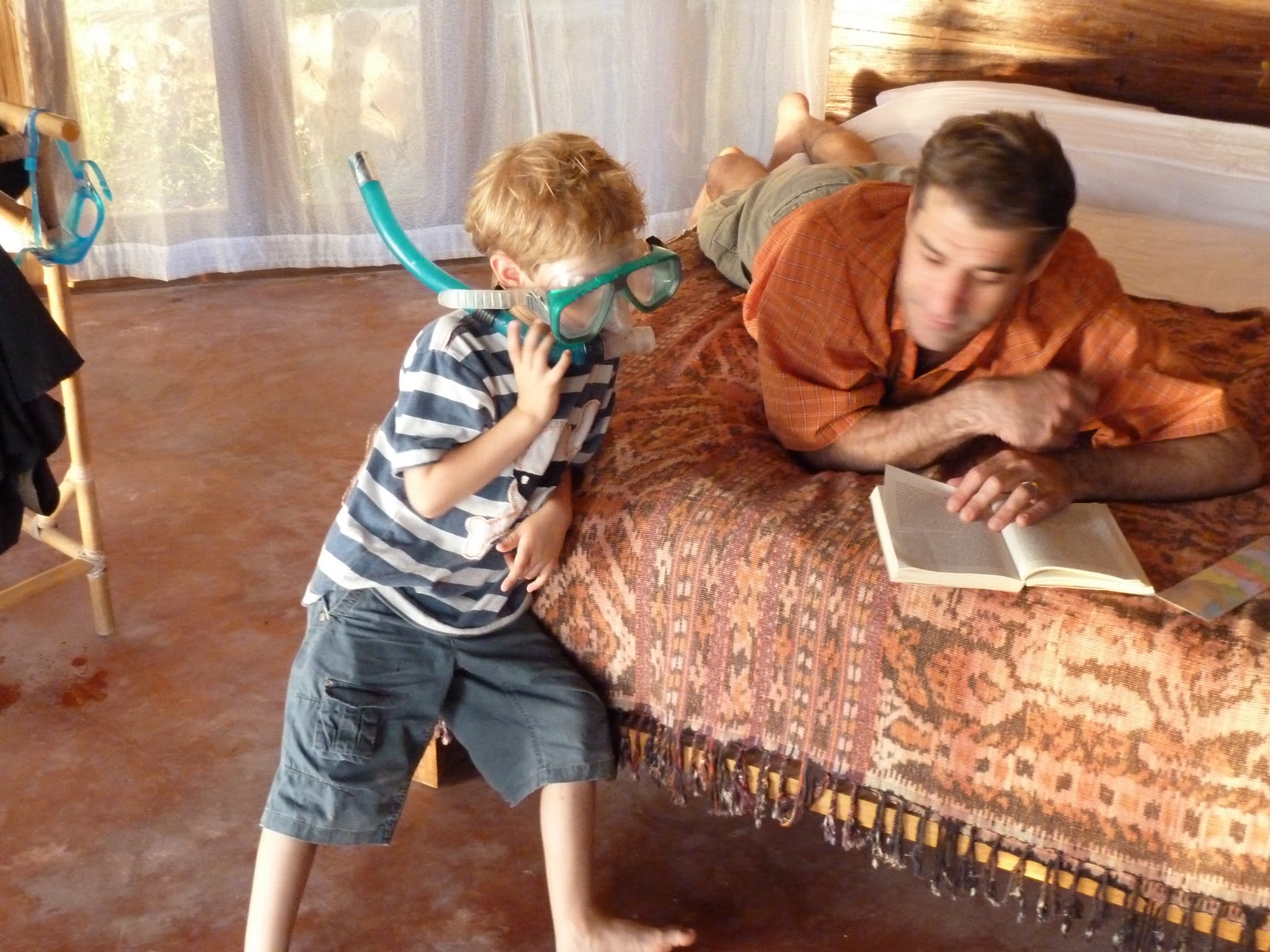
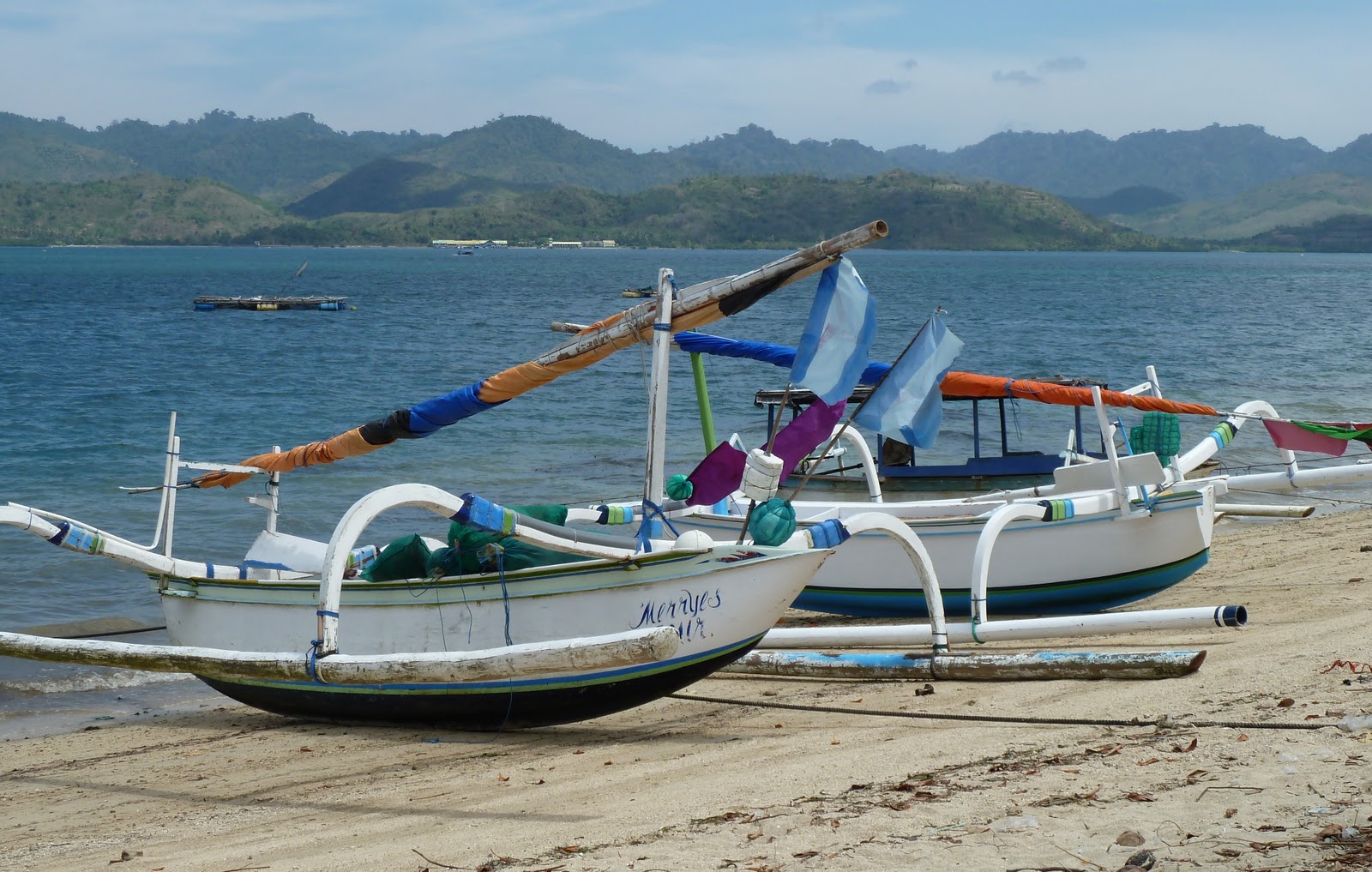
When we arrived at Via Vacare on Gili Gede, a small island off the southwest coast of Lombok, the island to the east of Bali, we enjoyed a completely different experience.  While we were by no means "pampered," our 6-day stay at Via Vacare was undoubtedly the most relaxing part of our trip.  Without cars (or roads) to take us anywhere, without restaurants to beckon us, we were able to just sit still.  We enjoyed hour upon hour swinging in hammocks and going to bed when the electricity went out after dinner.  Enjoying a solar shower in our open air bathroom was our luxury -- otherwise, we bathed using a maundi jar and carried buckets of water up from the beach to flush our toilet.  We did make a day of fantastic snorkeling off the coral reefs surrounding a nearby island, and Evan and I each enjoyed one walking trip around the island -- a few hours in the hot sun, passing several fishing villages, each with its own mosque and slightly different ambience.  Otherwise, we played with Ari, read, walked, collected amazing seashells, talked with the other guests and swung some more. Meals were served in the main house and were usually delicious.  


first morning's seashells
The owner is an Indonesian Dutch woman who still lives part time in the Netherlands.  Luckily she was in residence at Via Vacare during our stay, and we were fortunate to have her company.  She worked many years as a personal and professional coach/trainer and her people skills are wonderful.  The overall ambience is just so laid-back, you can't help but open up and let her draw you into personal conversation.  Vacare basically translates as "become vacant, be without, idle, do nothing, laze around" and Jet (the owner) encourages visitors to use their stays to slow down, to "regain breath after exhausting exertions," to take time to think about work and life and come to terms with intense past events and to distance oneself from daily routine. 

The two main drawbacks of the place are that it lacks electricity other than a few hours a day around breakfast and dinner, and that there is no running water in the bungalows during the dry season.  Despite being located right on the beach, there were insufficient breezes a couple of the nights we were there to keep cool, which made sleeping difficult without a fan. 


And let's face it - it gets old not being able to flush toilet paper (as those of us who have traveled in places like India or South America can attest), or to run water to wash your hands.  After a couple of days, the ill-fitting lid on the maundi jar meant that the water for bathing was no longer crystal clear, and we spoiled Americans are not used to things that are not so clean we can see our reflections in them (think the "anti-anti-phosphate" freakout currently revving up the Tea Partiers http://www.guardian.co.uk/commentisfree/cifamerica/2010/oct/13/phosphate-ban-dishwash-detergent).  All said, I'd go back.  Maybe after another "exhausting exertion" like getting ready to move to the other side of the world. . . .